Retouching & compositing
Car compositing: the ground has to agree
A practical approach to placing a car in a new scene: match the viewpoint, establish tyre contact and build shadows that belong to the ground.
 By Ed McCulloch ·

A carefully cut-out car can still look placed on top of a photograph. The paint may be convincing and the colour grade attractive, yet the vehicle seems weightless. Often the first problem is the relationship between the tyres and the ground.
Car compositing starts with that relationship. Before refining reflections or adding a campaign finish, establish a compatible viewpoint, credible scale and a surface that can support the vehicle. Those decisions make the later retouching more useful.
Choose compatible source views before cutting out
Compare the camera height and visible surfaces in the car source and the proposed location. How much roof can you see? Where do the wheel centres sit relative to the horizon? Which parts of the ground are visible around the vehicle? A high view of the car can conflict with a location photographed close to the road.
Ground joints and architectural lines can help you read the scene, but they are clues rather than a complete camera calibration. When precision matters, request camera information, a measured reference or a suitable 3D setup. A different source view can be a better choice than forcing a large perspective correction into the bodywork.
Set the footprint and scale together
Place the tyres against one coherent ground plane. Check the visible contact points together rather than nudging each wheel until it looks locally plausible. The car also needs a believable relationship with the surrounding kerb, doorway or parking bay; an attractive composition can conceal a scale mistake.
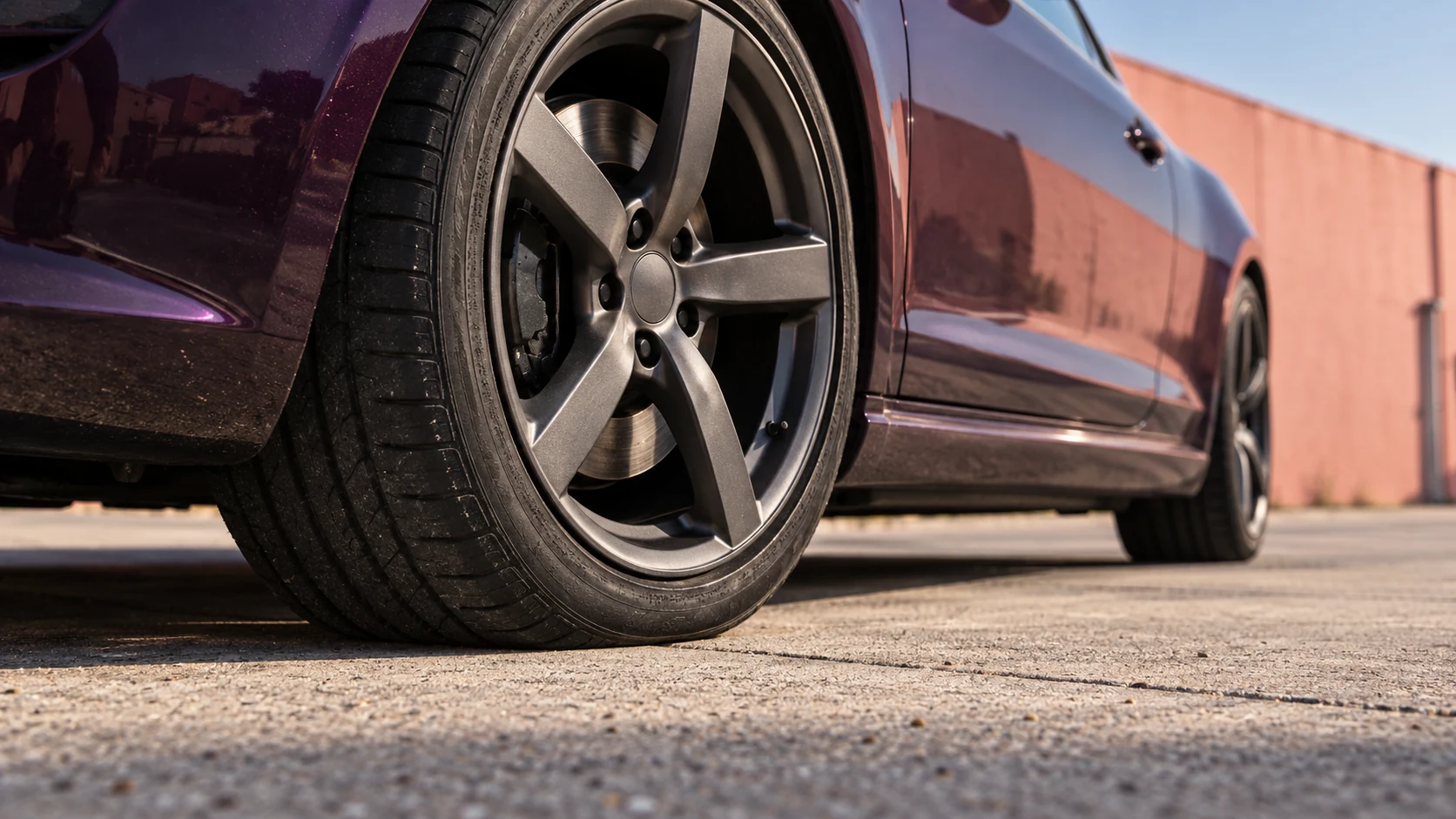
In the plum-coupe concept, the open concrete and building give the vehicle a spatial context. This is an original AI-generated illustration, not an actual source-to-composite demonstration. For a commissioned car image, approved source photography or accurate geometry must establish the vehicle, proportions and wheel placement.
Separate tight contact from the broader shadow
The narrow dark region where a tyre meets the surface does a different job from the shadow beneath the whole car. Contact describes the join. The broader shadow describes the surrounding illumination and the vehicle blocking it. Painting one uniform dark oval can make the car feel stuck to a graphic rather than parked in a place.
The wheel detail makes those regions easier to discuss. Look for a convincing lower tyre edge, a tight area of darkness at contact and a broader transition across the concrete. Match shadow direction and softness to the location. Avoid a universal blur setting: ground angle, distance from the surface and the light source all affect the result.
Let the ground keep its character
A shadow changes the ground beneath it; it does not normally replace that ground with featureless black. Preserve appropriate surface variation and check whether a repaired area still follows the surrounding concrete or asphalt. Tyre edges should also share the scene’s focus and capture character.
Keep the surface condition consistent. Dry concrete, wet tarmac and polished flooring behave differently. A bright reflected car shape on a matte road can undermine the composite, even if it is visually appealing. Likewise, an extremely clean tyre against a dusty setting may need a deliberate explanation or a more suitable source.
Check the surroundings in the car as well
Once the car sits convincingly, return to the bodywork and windows. Broad reflections should have a plausible relationship with the new environment. A location change can leave an old building reflected in a door or a bright studio strip running through a window. Those clues may require another source exposure, selective reconstruction or a 3D contribution.
Review the complete image at delivery size, then inspect the tyres, lower body and shadow edges more closely. Compare against the approved car reference throughout. The aim is a vehicle that feels photographed in the location, with its construction preserved—not simply a cleaner cut-out or a more dramatic grade.